
On this page
- The direct answer
- Myth 1: “It grows back thicker”
- Myth 2: “Dermaplaning is just shaving”
- Myth 3: “It’s not safe”
- Myth 4: “It causes breakouts”
- Myth 5: “You can do it properly at home”
- Myth 6: “It thins your skin over time”
- Myth 7: “It’s only for people with a lot of facial hair”
- How often can you dermaplane?
- Frequently asked questions
The direct answer
No. Dermaplaning does not make hair grow back thicker, darker or coarser. Hair thickness is determined by the follicle beneath the skin, and dermaplaning only cuts the shaft at the surface. Cutting a hair cannot change the structure that produced it. What changes is the tip: a hair that grew to a fine, tapered point now has a blunt cut end, which feels coarser to the touch and catches light differently.
That is the entire illusion, and it applies equally to shaving anywhere on the body.
Myth 1: “It grows back thicker”
Vellus hair — the fine, pale hair on the face — tapers as it grows, so the tip is the narrowest part of the shaft. Cut it and you are now feeling the mid-shaft, which is wider than the tip was. The follicle’s diameter, growth rate and pigment production are unchanged, because none of them were touched.
Regrowth typically becomes noticeable at two to four weeks, and once the hair regrows to a length where it starts tapering again, that blunt feeling disappears.
The only things that genuinely change facial hair are hormonal shifts, medication and certain medical conditions. A blade at skin level is not among them.
Myth 2: “Dermaplaning is just shaving”
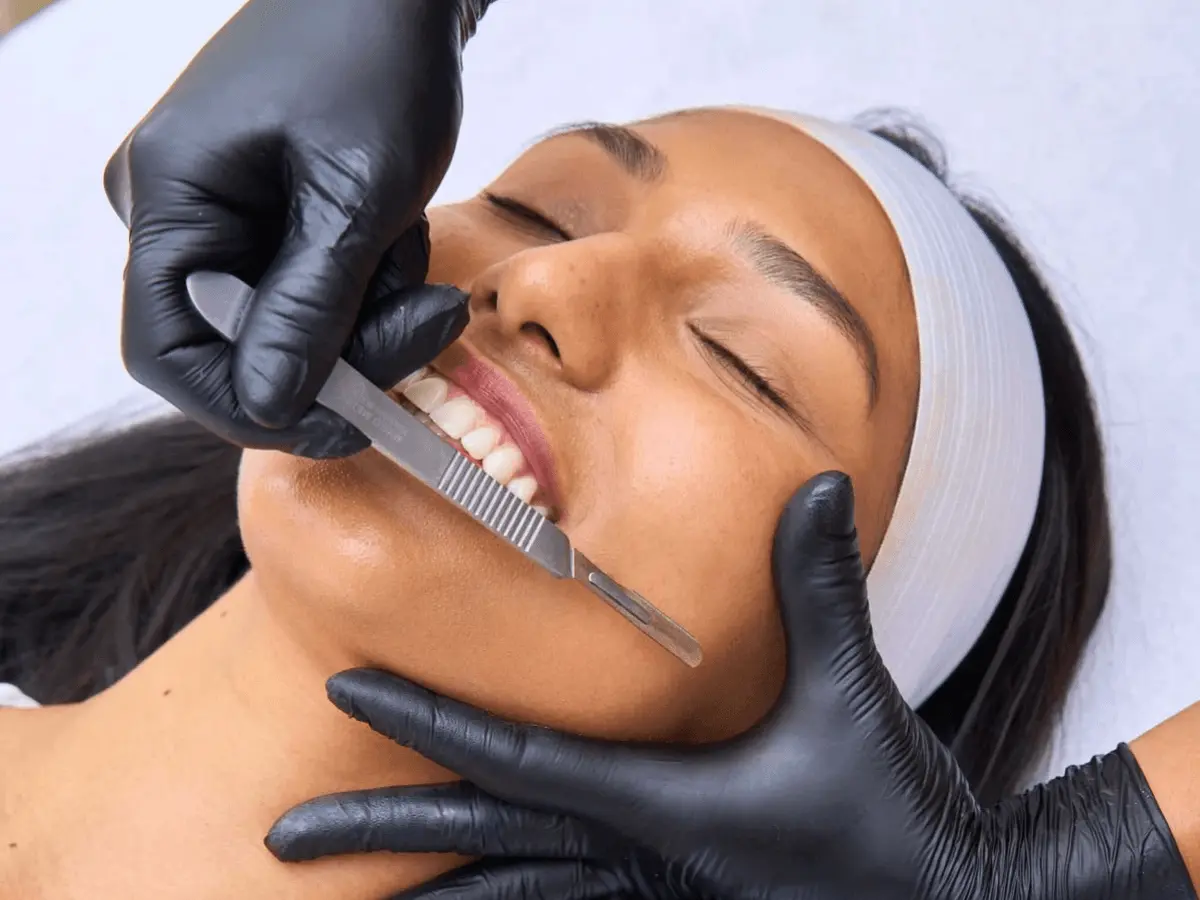
Related, but not identical. Shaving uses a guarded blade at a low angle to remove hair, and skin contact is incidental. Dermaplaning uses a sterile surgical scalpel held at roughly a 45-degree angle, drawn across taut skin, with the deliberate intent of removing the stratum corneum — the layer of dead cells — along with the vellus hair. It is physical exfoliation that happens to remove hair too.
That distinction is why a professional treatment produces noticeably more glow than shaving at home, and why blade angle and skin tension matter enough to warrant training.
Myth 3: “It’s not safe”
Performed correctly on suitable skin, dermaplaning is a low-risk treatment. The realistic risks are technique-related: nicks from poor angle or loose skin, irritation from going over the same area repeatedly, and infection from a reused or non-sterile blade. A professional uses a fresh sterile blade for every client and every session.
It is not suitable for everyone. Avoid it with active inflammatory or cystic acne (dragging a blade over pustules spreads bacteria), active eczema, psoriasis or dermatitis in the area, sunburn, cold sores, or on skin currently or recently treated with isotretinoin. A history of keloid scarring is also a reason to choose a different method.
Myth 4: “It causes breakouts”
Dermaplaning does not cause acne — it does not add bacteria or block pores. Two things can happen that get blamed on it.
First, removing a layer of dead cells and hair makes everything you apply afterwards penetrate better, including comedogenic products. Second, exfoliation can accelerate existing congestion to the surface, which is purging rather than a new breakout. How to tell the difference is worth knowing before you conclude a treatment disagreed with you.
If you have active acne, dermaplaning should wait until it settles.
Myth 5: “You can do it properly at home”
You can use a home dermaplaning tool, and many people do without incident. What you cannot easily replicate is a surgical-grade blade at a consistent 45-degree angle on skin held properly taut, over areas you cannot see well. Home tools are deliberately duller for safety, which means less exfoliation — closer to shaving than to dermaplaning.
Home use also invites the commonest mistake: doing it too often. Skin needs its turnover cycle.
Myth 6: “It thins your skin over time”
Dermaplaning removes dead cells from the stratum corneum, which is not living tissue and is continuously replaced. Done at appropriate intervals it does not thin the skin.
Done too frequently — weekly, or stacked with acids and scrubs — it can compromise the moisture barrier, producing sensitivity, redness and dehydration. That is over-exfoliation, and it is a function of frequency rather than the method itself. The turnover cycle explains where the intervals come from.
Myth 7: “It’s only for people with a lot of facial hair”
Most people book dermaplaning for the skin result rather than the hair. Removing the dead surface layer leaves skin smoother, makes makeup sit flat instead of catching on peach fuzz, and improves the absorption of serums applied afterwards. Hair removal is a side effect people happen to like.
How often can you dermaplane?
Every four weeks for most skin, which tracks the roughly 28-day epidermal turnover cycle. Mature skin turns over more slowly and often does better at five to six weeks. Sensitive skin should stretch the interval further.
Do not stack it with other exfoliation in the same week — no peels, scrubs, retinoids or strong acids for several days either side. Where dermaplaning sits among the other exfoliation options is covered in our comparison of the main treatment categories.
Frequently asked questions
Does dermaplaning hurt? No. It feels like light scraping or brushing. There is no downtime beyond possible mild redness for an hour.
Will stubble appear as it grows back? Fine facial hair does not produce stubble. It regrows soft, with a blunt tip for a week or two before it tapers again.
Can I dermaplane if I have dark facial hair? Yes, though coarse dark terminal hair regrows more visibly and may suit waxing or threading better.
How long do the results last? Smoothness and glow last two to four weeks, tracking the skin’s own turnover cycle.
Written by Parull G Chandna, Advanced & Medical Aesthetics at Kaaya Skin & Hair Studio, London, Ontario. Explore our facial and skin care treatments to find the right exfoliation method for your skin.