
On this page
The short answer
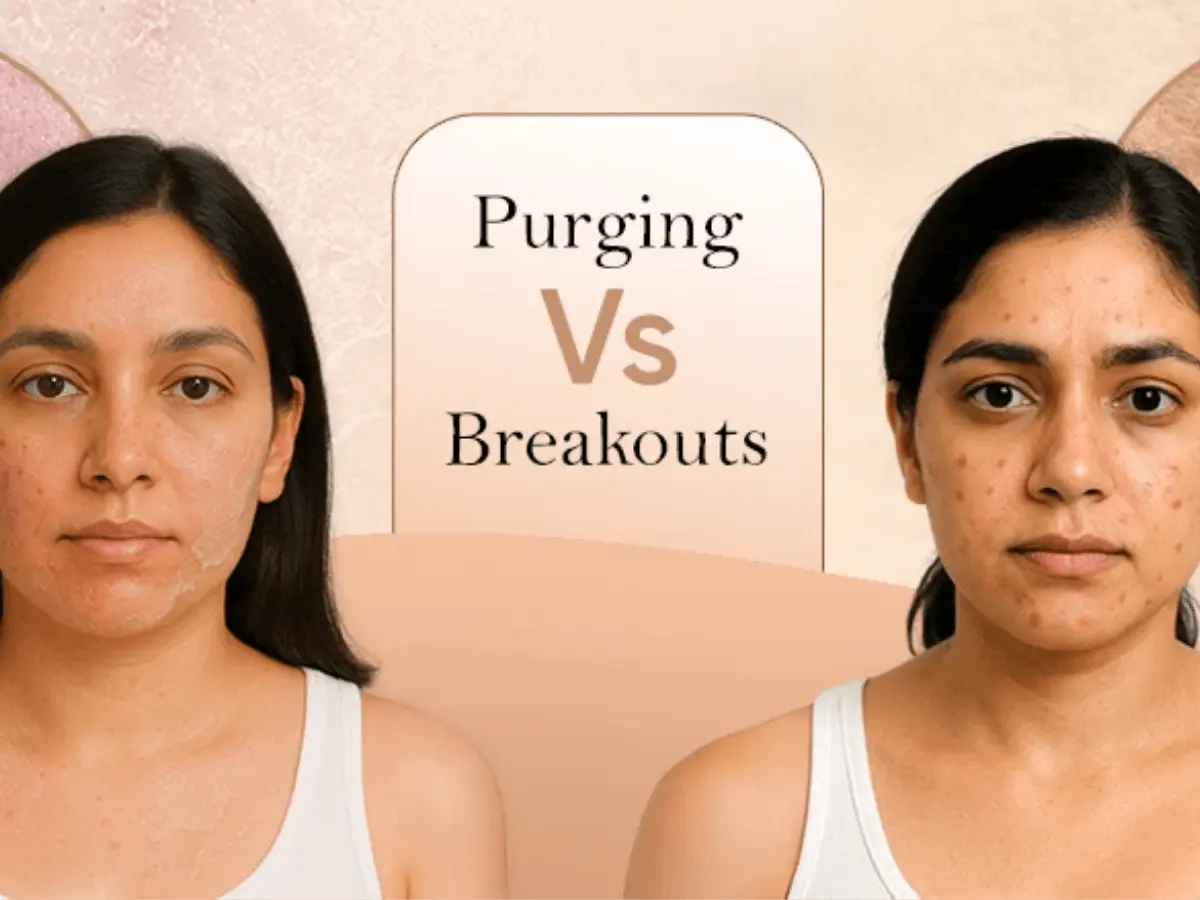
Purging is accelerated skin cell turnover pushing existing congestion to the surface faster than normal. It appears only where you already tend to break out, arrives within days of starting a new active, peaks quickly and clears within four to six weeks. A breakout or reaction appears in areas you do not normally break out, keeps getting worse, and often brings itching, burning, stinging or rash-like redness.
Location, timing and trajectory are what separate them.
What is skin purging?
Your skin renews itself on a cycle of roughly 28 days. Certain ingredients — retinoids, AHAs, BHAs, benzoyl peroxide — speed that cycle up. Professional exfoliating treatments do the same.
Underneath the surface, microcomedones are already forming: tiny plugs of sebum and dead cells that would have surfaced as visible spots over the following weeks regardless. Accelerating turnover brings all of them up at once. You are not developing new congestion — you are watching several weeks of it arrive on a compressed schedule.
That is why purging looks alarming and is, mechanically, a sign the product is doing what it was designed to do.
Four tests to tell them apart
Test one: where is it happening?
The most reliable signal. Purging occurs in your usual problem areas, because that is where the microcomedones already were. If you break out along the jaw and chin and the new spots are on the jaw and chin, that pattern fits purging.
If spots appear somewhere you never break out — cheeks when you are normally a chin person, or the neck — that is a reaction to the product.
Test two: how quickly did it start?
Purging starts within a few days to two weeks of introducing an actives-based product or an exfoliating treatment.
If a product you have used for months suddenly triggers spots, that is not purging — something else changed. And an immediate reaction within hours, with stinging or burning, is irritation, not purging.
Test three: what do the spots look like?
Purging tends to produce small, superficial whiteheads and papules that come to a head quickly and resolve in days — faster than your normal spots.
Reactions more often bring deeper, painful cystic lesions, small itchy bumps, widespread rash-like redness, or dryness and flaking alongside the spots. Itching and burning are not features of purging.
Test four: is it improving or escalating?
Purging follows an arc: worse for two to four weeks, then clearly better, and resolved by six weeks. Plot it in your head.
A reaction has no such arc. It stays bad or worsens. Six weeks in with no improvement means stop, regardless of what the product is supposed to do.
| Purging | Breakout or reaction | |
| Where | Your usual problem areas | New areas |
| Onset | Days to 2 weeks after a new active | Any time; often immediate |
| Look | Small surface whiteheads, quick to clear | Deep cysts, itchy bumps, rash, dryness |
| Sensation | Normal | Itching, burning, stinging |
| Course | Peaks then clears by 4–6 weeks | Persists or worsens |
Which ingredients cause purging — and which never do
Purging is only plausible with something that accelerates cell turnover:
• Retinoids — retinol, retinaldehyde, tretinoin, adapalene
• Alpha hydroxy acids — glycolic, lactic, mandelic
• Beta hydroxy acid — salicylic
• Benzoyl peroxide
• Vitamin C at higher concentrations, sometimes
• Professional peels, microdermabrasion, hydradermabrasion, dermaplaning
If your new product is a moisturiser, a hyaluronic acid serum, an oil, a sunscreen or a cleanser, it cannot cause purging — those do not affect turnover rate. Spots after starting one of those are a reaction, most often to an occlusive or comedogenic ingredient. That distinction alone resolves most of the confusion.
Purging after a facial or a peel
Common, and expected after exfoliating treatments. A peel, microdermabrasion or hydradermabrasion session compresses weeks of turnover into one appointment, so congestion surfaces over the following one to two weeks — often around days three to seven.
Extractions can also leave temporary redness and small bumps for a couple of days, which is trauma response rather than purging.
The rule stays the same: same areas, improving within a few weeks, no itching. If new spots spread beyond the treated pattern, or the skin is stinging days later, contact your provider. Our day-by-day peel aftercare guide sets out what normal looks like and the specific warning signs worth a call.
How long does skin purging last?
Four to six weeks, matching one full turnover cycle. Some people clear in three; some retinoid users take up to eight to twelve weeks to fully settle.
Beyond eight weeks with no improvement, stop assuming it is purging. Either the product does not suit you or your routine is over-loaded.
How to get through it without making it worse
Do not stop and restart. Repeatedly quitting and reintroducing an active restarts the purge each time and stretches a six-week process across months.
Reduce frequency instead. Twice weekly, building to alternate nights, gets you to the same destination with less turbulence. Buffering a retinoid over moisturiser also helps.
Strip everything else back. During a purge, run a bland cleanser, a simple moisturiser, sunscreen and the one active. Adding a second exfoliant to fix the spots is how a purge becomes barrier damage.
Do not pick. This matters more than anything else here — especially on deeper skin tones, where inflammation converts to pigment readily. A picked purge spot leaves a mark that outlasts the purge by months. Why melanin-rich skin holds pigment longer explains the mechanism.
Keep sunscreen on. Accelerated turnover leaves fresh skin at the surface with less UV defence.
When to stop and get advice
Stop the product and seek professional input if you see swelling, hives, spreading rash or blistering; if the spots are deep, painful and cystic; if the skin is stinging or burning; or if nothing has improved after eight weeks. Reactive skin does not benefit from being pushed through.
Frequently asked questions
Is skin purging a good sign? It means an active is accelerating turnover as intended. It is not necessary for a product to work — plenty of people never purge.
Can moisturiser cause purging? No. Moisturisers do not accelerate turnover. Spots after a new moisturiser are a reaction to an ingredient in it.
Should I stop using the product while purging? Usually not — reduce frequency instead. Stopping and restarting prolongs the process.
Can purging happen on the body? Yes, wherever actives are applied — back, chest and shoulders behave the same way.
Written by Parull G Chandna, Advanced & Medical Aesthetics at Kaaya Skin & Hair Studio, London, Ontario. If you are unsure whether your skin is purging or reacting, book a consultation or explore our skin care treatments.