On this page
- The short answer
- Why the mechanism matters more than the menu name
- Microdermabrasion: mechanical exfoliation
- Hydradermabrasion (the HydraFacial category): exfoliation plus infusion
- Chemical peels: acid-driven exfoliation
- Comparing the three at a glance
- Which category matches which concern
- Frequently asked questions
The short answer
All three remove dead surface skin, but they get there differently. Microdermabrasion is mechanical abrasion — crystals or a diamond tip physically sand the surface. A HydraFacial-style treatment is hydradermabrasion — a vortex tip loosens debris with fluid, suctions it away and infuses serum in the same pass. A chemical peel uses acids to dissolve the bonds between dead cells so they release. Mechanical, hydro-mechanical, chemical.
Why the mechanism matters more than the menu name
Every clinic names its facials differently. What does not change is physics and chemistry: something is either scraping the surface, flushing it, or chemically loosening it. Once you know which of the three a treatment is doing, you can predict how it will feel, how much downtime it carries and what it can realistically change.
Microdermabrasion: mechanical exfoliation
A handpiece either sprays fine crystals across the skin or passes a diamond-encrusted tip over it, while suction lifts away the loosened cells. It works on the stratum corneum — the outermost, non-living layer — which is why it is a surface treatment by definition.
What it reaches: the topmost layer of the epidermis. How it feels: a firm, gritty scratching with a tugging sensation from the suction. Downtime: essentially none. Mild redness for an hour or two. Best suited to: dullness, rough texture, congestion and enlarged-looking pores on skin that tolerates physical exfoliation. Its limit: it cannot reach the dermis, so it does not remodel scars or deep lines. It also suits some skin poorly — active inflammatory acne, rosacea-prone skin and very reactive skin generally do better with a non-abrasive method.
Hydradermabrasion (the HydraFacial category): exfoliation plus infusion
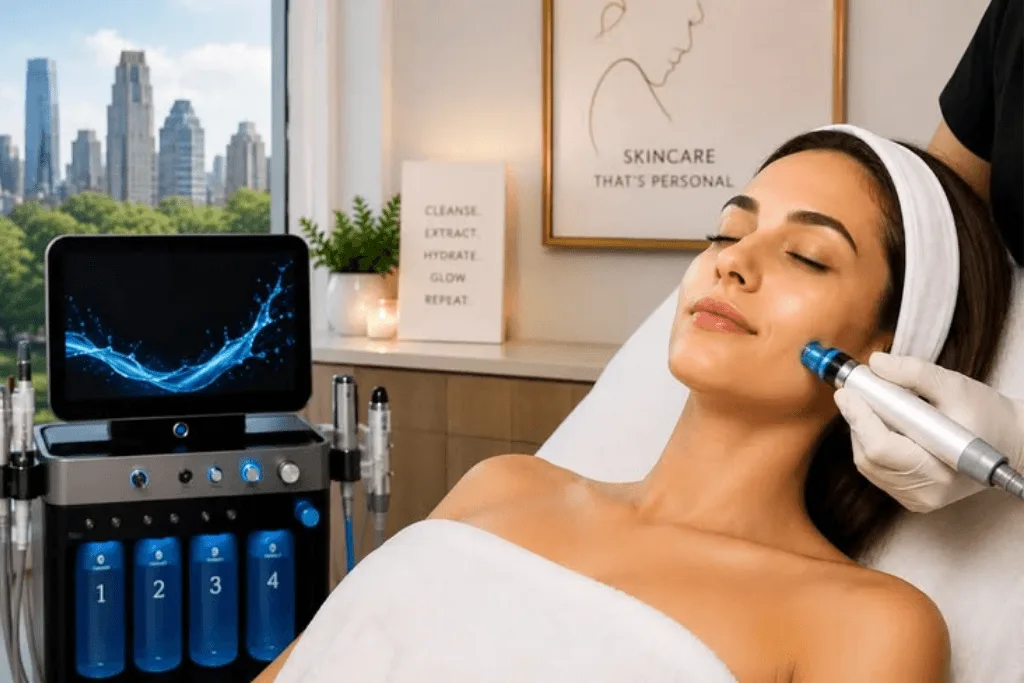
The distinguishing feature is that exfoliation and hydration happen simultaneously rather than in sequence. A spiral tip delivers a fluid solution — usually a mild acid blend — that loosens debris, while vortex suction extracts it, and a final pass drives in serums such as hyaluronic acid, peptides or antioxidants.
What it reaches: the epidermis, with mild chemical action from the solutions used. How it feels: cool and wet, a bit like a small vacuum gliding over the skin. Comfortable. Downtime: none. Skin usually looks better immediately. Best suited to: dehydration, dullness, congestion and anyone who wants visible glow with no recovery period — the classic pre-event treatment. Its limit: the results are real but relatively short-lived. It is maintenance, not transformation.
Chemical peels: acid-driven exfoliation
A peel applies an acid at a controlled strength and pH for a controlled time. Rather than sanding cells off, the acid breaks the desmosomal bonds holding dead cells together so they release. Depth depends entirely on the acid, its concentration and how long it stays on.
• Alpha hydroxy acids (glycolic, lactic, mandelic) are water-soluble and work on the surface. Lactic and mandelic are the gentler options and are often chosen for melanin-rich skin because they carry a lower risk of triggering pigment.
• Beta hydroxy acid (salicylic) is oil-soluble, so it penetrates into the pore lining — the reason it suits oily and acne-prone skin specifically.
• Blended and stronger medium-depth peels reach the upper dermis and are where meaningful change to pigmentation and fine lines happens, at the cost of real downtime.
What it reaches: anywhere from the surface to the upper dermis, depending on formulation. How it feels: tingling, warmth, sometimes a sharp sting for the first minute. Downtime: none for a light peel; three to seven days of flaking for a medium one. Best suited to: pigmentation, post-inflammatory marks, acne, sun damage and fine lines. Its limit: it demands aftercare discipline. Sun exposure and picking during the peeling phase are how good peels turn into pigment problems — our day-by-day chemical peel aftercare guide covers exactly what that week should look like.
Comparing the three at a glance
| Microdermabrasion | Hydradermabrasion | Chemical peel | |
| Mechanism | Physical abrasion | Fluid + suction + infusion | Acid dissolves cell bonds |
| Depth reached | Surface epidermis | Epidermis | Surface to upper dermis |
| Downtime | None | None | None to 7 days |
| Hydrating? | No | Yes, actively | No — often drying |
| Strongest for | Rough texture, congestion | Dullness, dehydration, glow | Pigment, acne, sun damage |
Which category matches which concern
If skin looks dull and flat but is otherwise healthy, surface exfoliation of any kind will help. If it is dehydrated and tight, hydradermabrasion addresses the exfoliation and the water deficit at once — and if you are not sure whether your skin is dry or dehydrated, those are genuinely different problems. If the concern is pigment, marks left behind by old breakouts, or oil sitting in the pores, that is chemical territory, because acids can do things abrasion physically cannot.
A note for anyone with deeper skin tones: aggressive physical exfoliation is a common trigger for post-inflammatory hyperpigmentation. Gentler chemical options at conservative strengths are usually the better route, which is a large part of why layered, hydration-led approaches such as the Korean glass skin method have become popular.
Frequently asked questions
Is a HydraFacial just an expensive microdermabrasion? No. Microdermabrasion abrades and removes; hydradermabrasion loosens, extracts and infuses in one pass and leaves skin hydrated rather than stripped.
Can you combine them? In a course, yes — but not on the same day. Stacking exfoliation methods in one session compromises the barrier.
Which one is best for acne? Usually a salicylic-based peel, because it is oil-soluble and works inside the pore. Abrasion over inflamed lesions tends to spread bacteria and worsen the picture.
Do any of these help acne scars? Peels can improve shallow scarring and discolouration. True indented scarring needs collagen stimulation — see what microneedling actually does.
Written by Parull G Chandna, Advanced & Medical Aesthetics at Kaaya Skin & Hair Studio, London, Ontario. Browse our full range of skin care treatments or book a consultation to work out which category fits your skin.