
On this page
Start with hair type, not face shape
Face shape gets all the attention, but it is the second consideration. A cut that fights your hair’s density, texture or growth pattern will not sit correctly no matter how well it suits your bone structure — and a cut that works with your hair usually flatters your face by default.
Three properties decide what a cut will do:
Density — how many strands you have. Determines whether layers add movement or create thin, wispy ends. Texture — the diameter of each strand. Fine, medium or coarse. Determines how much weight the hair can hold. Pattern — straight, wavy, curly or coily, plus cowlicks and growth direction. Determines where the hair wants to fall.
Density and texture are independent. Fine, dense hair is common and behaves very differently from coarse, sparse hair — a distinction that explains why the same cut looks entirely different on two people.
Cutting by hair type
Fine hair
Fine strands cannot support weight, so heavy layering removes the density you have. Blunt ends create the illusion of thickness because every strand terminates at the same point. Long, heavy lengths drag flat under their own weight.
Works: blunt bobs, lobs, one-length cuts, minimal long layers, a slight graduation for lift at the crown. Avoid: heavy internal layering, aggressive thinning shears, very long lengths.
Thick or coarse hair
The problem here is bulk, not volume. Thick hair cut all one length forms a triangle — flat on top, wide at the bottom.
Works: internal layers and controlled thinning to remove weight from underneath while keeping the outer line intact, long layers to distribute the mass. Avoid: blunt one-length cuts at chin length, over-thinning near the ends (which causes frizz and flyaway).
Wavy hair
Waves need weight to keep their shape but bulk out at the mid-lengths if left unlayered.
Works: long layers, soft graduation, lobs. Face-framing pieces that follow the wave rather than cut across it. Avoid: short blunt cuts that push waves outward, over-layering that turns a wave into frizz.
Curly and coily hair
Curls are cut differently for a structural reason. A curl’s finished length is dramatically shorter than its stretched length — commonly 30–50% shorter, and more on tight coils.
That is why curls are cut dry, or at minimum checked dry. Cutting wet and stretched means the stylist is guessing at where the hair will land, and the standard outcome is hair two inches shorter than requested.
Works: dry cutting, curl-by-curl techniques, shaping layers that remove weight without collapsing the curl pattern, longer layers to prevent the triangle. Avoid: wet cutting without accounting for shrinkage, thinning shears (they break the curl pattern and cause frizz), razors on curly hair.
Curl health also depends on scalp condition — dry scalp and dandruff are different problems and both affect how hair sits.
What tension does to your finished length
Tension cutting — pulling hair taut while cutting — produces a shorter result than it appears in the mirror, because the hair rebounds when released. The effect is proportional to how much natural bend the hair has: minimal on straight hair, significant on wavy hair, dramatic on curly.
This, along with wet-versus-dry cutting, accounts for most of the “it’s shorter than I asked for” conversations that happen in salons. If you have any curl at all, say so before the first cut is made.
U cut versus V cut
Both describe the shape of the perimeter on long hair.
U cut: the back forms a rounded U. Fuller, more even, with less contrast between the shortest and longest points. Preserves more density at the ends and suits fine or medium hair wanting a thicker-looking finish.
V cut: the back tapers to a point. More dramatic and elongating, with a strong vertical line. Removes weight from the ends, which suits thick hair, and adds visible length.
The practical difference: a U cut keeps bulk, a V cut removes it. Choose by density.
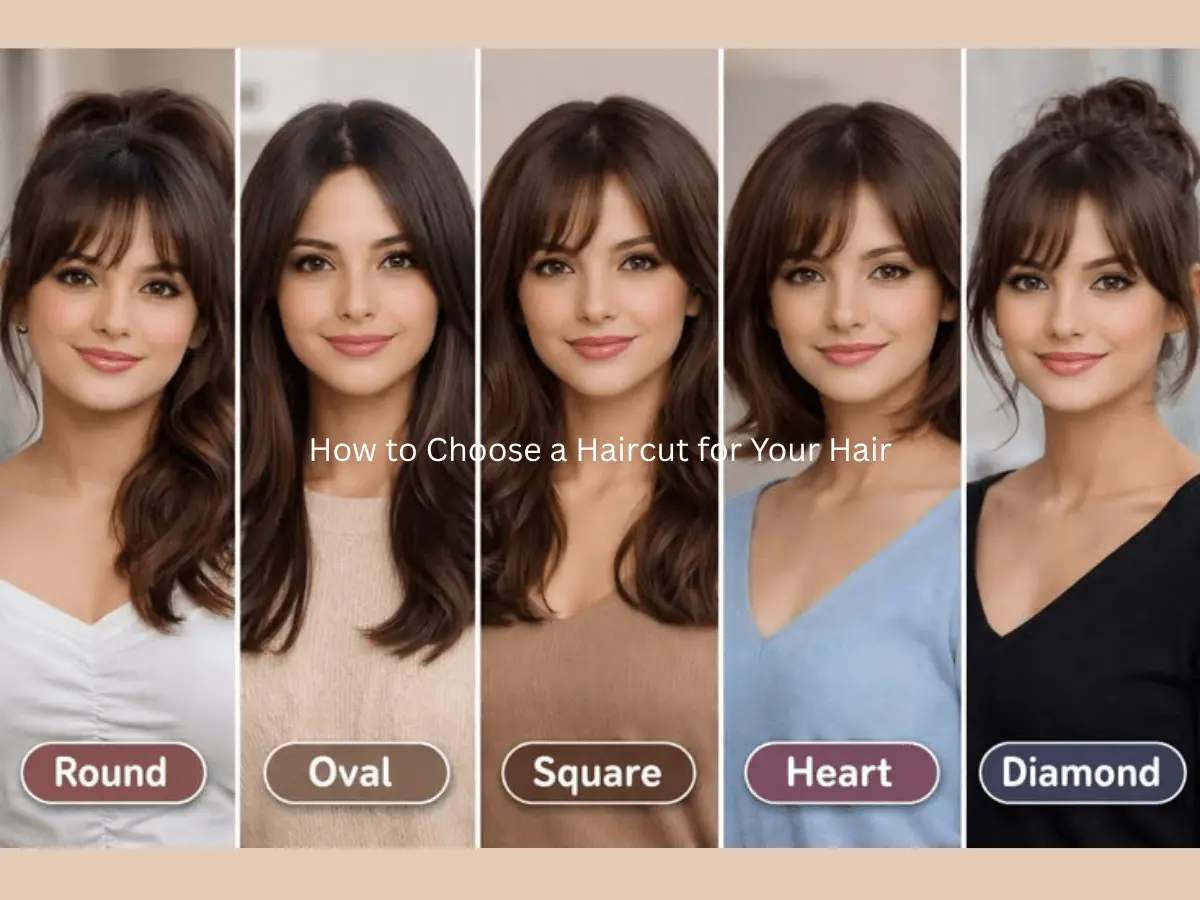
Face shape: what it actually adjusts
Face shape is about proportion and where the eye lands.
Round — length and vertical lines create the impression of an elongated face. Long layers starting below the chin, side parts, curtain bangs. A chin-length blunt bob adds visible width.
Oval — proportionally balanced, so most shapes work. Avoid heavy blunt fringes that shorten the visible face.
Square — soft layers and waves offset a strong jaw. Long side-swept pieces around the jawline. Blunt, hard lines emphasise the angle.
Heart — width at the jaw balances a wider forehead. Chin-length bobs, layers starting at the jaw, side-swept fringes. Very short blunt fringes emphasise the forehead.
Long or oblong — width rather than length. Blunt fringes, waves at cheek level, cuts ending around the collarbone. Very long, straight, unlayered hair extends the face further.
Diamond — softness at the cheekbones. Chin-length layers, side parts, textured ends.
Do curtain bangs suit everyone?
Close to it, which is why they have stayed popular. Their advantage is that they part in the middle and sweep outward, so they add width at the cheekbones without cutting horizontally across the forehead — they frame rather than shorten.
Two caveats. A strong cowlick at the hairline will fight the parting daily. And curly hair needs curtain bangs cut longer and dry, since shrinkage can take a shape meant to hit the cheekbone up to the eyebrow.
Bangs of any kind commit you to a trim every four to six weeks. That is the real cost.
Bringing it together
Ask three questions in order:
1. What will my hair actually do? Density, texture and pattern set the boundaries.
2. How much time will I spend on it? A cut that only works after 25 minutes of styling is the wrong cut.
3. What proportion am I creating? Where the shortest point lands relative to the jaw, chin and collarbone matters more than the label on the style.
If you are colouring as well, technique and cut should be planned together — placement follows the shape of the cut, which is why the two are best discussed at the same appointment.
Frequently asked questions
Should curly hair be cut wet or dry? Dry, or at least checked and refined dry, because curls shrink by 30–50% and cutting wet means guessing at the finished length.
What haircut suits a round face? Cuts that add vertical length: long layers below the chin, side parts, curtain bangs. Chin-length blunt bobs tend to add width.
What’s the best cut for fine, thin hair? Blunt ends and minimal layering. A blunt bob or lob creates the appearance of density; heavy layers remove it.
How often should I get a trim? Six to eight weeks for short cuts and fringes; ten to twelve for long hair. Growing hair out still needs trims to stop splits travelling up the shaft.
Written by Parull G Chandna at Kaaya Skin & Hair Studio, London, Ontario. See our women’s haircut services or book a consultation to plan a cut around your hair type.