On this page
What is nanoplastia?
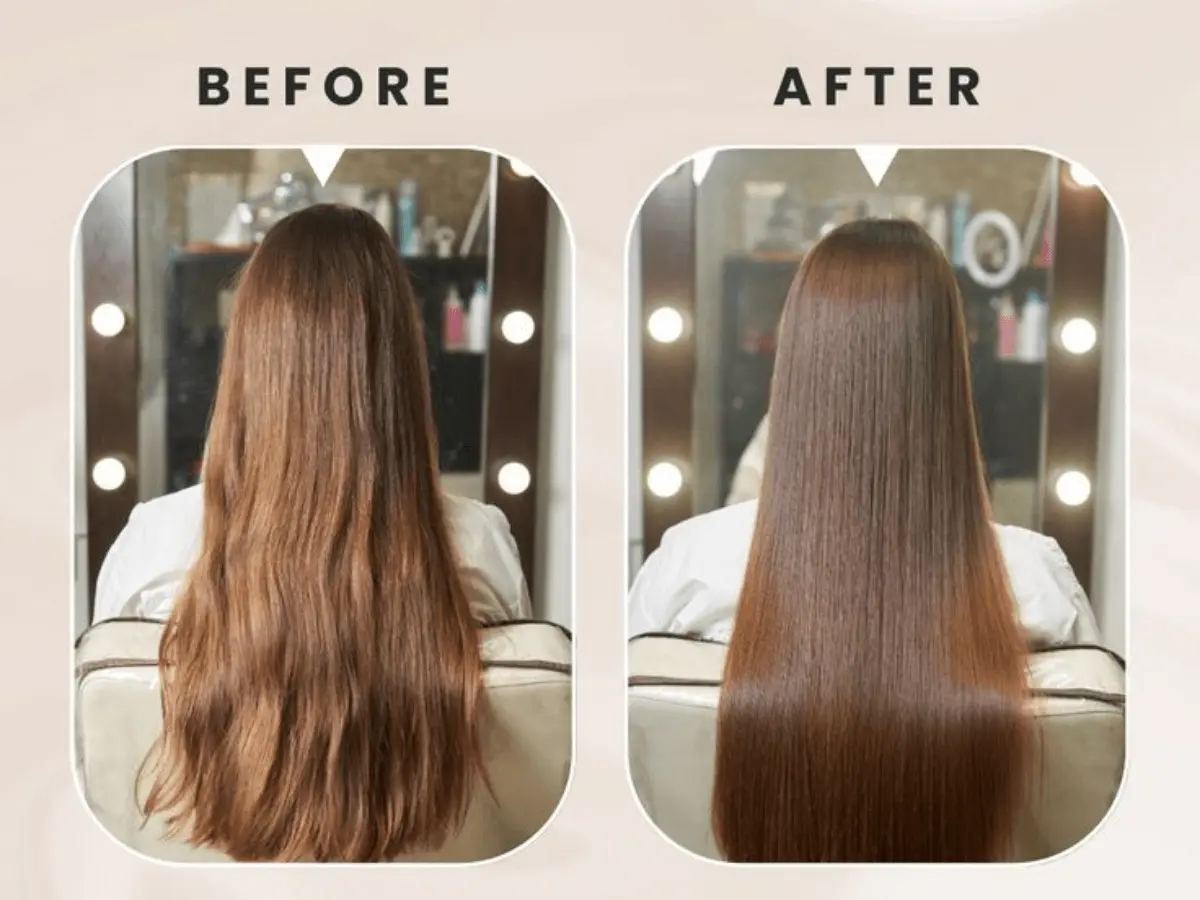
Nanoplastia is a hair smoothing treatment that uses very small amino-acid and organic-acid molecules to realign the internal structure of the hair shaft. Applied to the hair and activated with controlled heat, it reduces frizz and loosens curl pattern for roughly four to eight months. Unlike traditional keratin treatments, it contains no formaldehyde, and unlike relaxers, it does not permanently break the disulphide bonds that create curl.
The “nano” refers to molecular size. The molecules are small enough to penetrate the cuticle and reach the cortex, rather than sitting on the surface.
How it works, step by step
1. Deep clarifying wash. A clarifying shampoo strips product build-up, minerals and oils, and lifts the cuticle so the solution can enter. Hair from a hard-water area — much of Southwestern Ontario qualifies — often needs a chelating wash to remove mineral deposits first.
2. Application. The solution is applied in fine sections, root to tip, and left to process. The active ingredients — amino acids such as cysteine and arginine, plus an organic acid, most often glyoxylic acid — diffuse into the shaft.
3. Drying and heat sealing. Hair is blow-dried, then flat-ironed in thin sections at a controlled temperature. The heat is what completes the reaction: it drives the realignment and sets the new configuration. Temperature and pass count are the variables that decide whether the result is excellent or damaging.
4. Rinse and finish. Depending on the system, hair is rinsed and treated with a mask, or left unwashed for a set period.
The chemistry, without the jargon
Curl pattern is created by disulphide bonds — strong chemical links between sulphur atoms in the keratin protein. Chemical relaxers and perms break and re-form these bonds permanently, which is effective and also why they carry the highest damage risk.
Nanoplastia does not do that. Glyoxylic acid works primarily through hydrogen bonding and a reversible interaction with the keratin structure. Combined with heat, it holds the hair in a straighter configuration and stabilises it there. Because the disulphide bonds remain intact, the change is semi-permanent — it fades as the treatment washes out, rather than requiring the hair to grow out.
That is the trade-off in one sentence: less permanent than a relaxer, and considerably less structurally aggressive.
Is nanoplastia formaldehyde-free?
Properly formulated nanoplastia systems contain no formaldehyde and no formaldehyde-releasing agents such as methylene glycol or DMDM hydantoin. This is the main reason the treatment exists.
Traditional Brazilian blowouts and older keratin systems used formaldehyde to lock the shaft into a straightened form. Heating it releases formaldehyde gas, which is classified as a human carcinogen and is a known respiratory and eye irritant — a hazard for stylists most of all, given repeated daily exposure. Health Canada restricts formaldehyde in cosmetic products, and regulators internationally have moved in the same direction.
One caution worth stating plainly: “formaldehyde-free” is a claim, and not every product on the market is honest about it. There have been documented cases of hair-smoothing products testing positive for formaldehyde despite the label. Ask which brand and system your salon uses, and ask to see the ingredient list. A salon that cannot answer that is the wrong salon for this treatment.
Glyoxylic acid, the usual active, is not formaldehyde and does not release it — though it is worth noting that research into its own safety profile is ongoing, and good ventilation remains standard practice.
How long does nanoplastia last?
Four to eight months for most people, which is longer than keratin (three to five months) or hair botox (two to three months), because the change is structural rather than a coating that washes away.
Longevity depends heavily on:
• Wash frequency — every wash removes a little
• Shampoo — sulphates and sodium chloride strip it fast
• Hair porosity — highly porous, previously bleached hair releases it sooner
• Water quality — hard water and chlorine both shorten it
• Hair type — very coarse, tightly curled hair reverts faster
It fades gradually rather than ending abruptly, and it does not leave a demarcation line at the roots, which relaxers do.
Does nanoplastia damage hair?
Correctly performed on suitable hair, damage is minimal — meaningfully less than a relaxer or perm, since disulphide bonds are untouched, and many people find their hair in better condition afterwards because the cuticle is sealed and smoothed.
The risk is heat. Flat-ironing at excessive temperature or with too many passes causes real thermal damage, and no amino acid protects against a badly set iron.
Higher-risk situations:
• Heavily bleached hair, particularly above level 8
• Hair with existing severe breakage
• Recently relaxed or permed hair — stacking chemical processes is where disasters happen
• Very fine hair, which tolerates less heat
A strand test on a small hidden section is not an optional formality on compromised hair.
Nanoplastia on curly hair
It works well on curly and coily hair and is often chosen when keratin has not held. Expect substantial loosening: tight curls typically become waves, and waves become close to straight.
That is the thing to be certain about beforehand. If you want defined, healthy curls rather than looser ones, nanoplastia is the wrong treatment and hair botox is the one you actually want.
Side effects and who should avoid it
Reported side effects are usually mild: temporary scalp irritation, a distinct smell during processing, dryness if aftercare is neglected. Adequate ventilation during the service is standard.
Avoid it if you are pregnant or breastfeeding (a precautionary position most salons take), if your scalp is broken, inflamed or has open sores, if your hair is already severely damaged, or within two weeks of any other chemical service. An itchy, flaking scalp should be assessed first — dry scalp and seborrhoeic dandruff need opposite approaches, and neither should be sitting under a chemical service.
Aftercare
• Wait 48–72 hours before the first wash
• Sulphate-free and sodium-chloride-free shampoo, permanently
• Wash less often
• Use a heat protectant on hot tools
• Avoid chlorine and salt water where possible
• Deep condition every one to two weeks
Frequently asked questions
Is nanoplastia better than keratin? It lasts longer and contains no formaldehyde, but it is a longer service and demands more technical skill. “Better” depends on your hair type and priorities.
Will my hair be poker straight? No. Expect smooth with retained movement. For genuinely straight hair on tightly curled textures, a relaxer is the only permanent route — with a considerably higher damage cost.
Can I colour my hair afterwards? Wait about two weeks. Ideally colour first, then smooth.
How much regrowth before a retouch? Usually four to six months, when the new growth’s texture contrasts visibly with the treated lengths.
Written by Parull G Chandna at Kaaya Skin & Hair Studio, London, Ontario. See our nanoplastia and hair smoothing services or book a consultation for a strand test and assessment.