
On this page
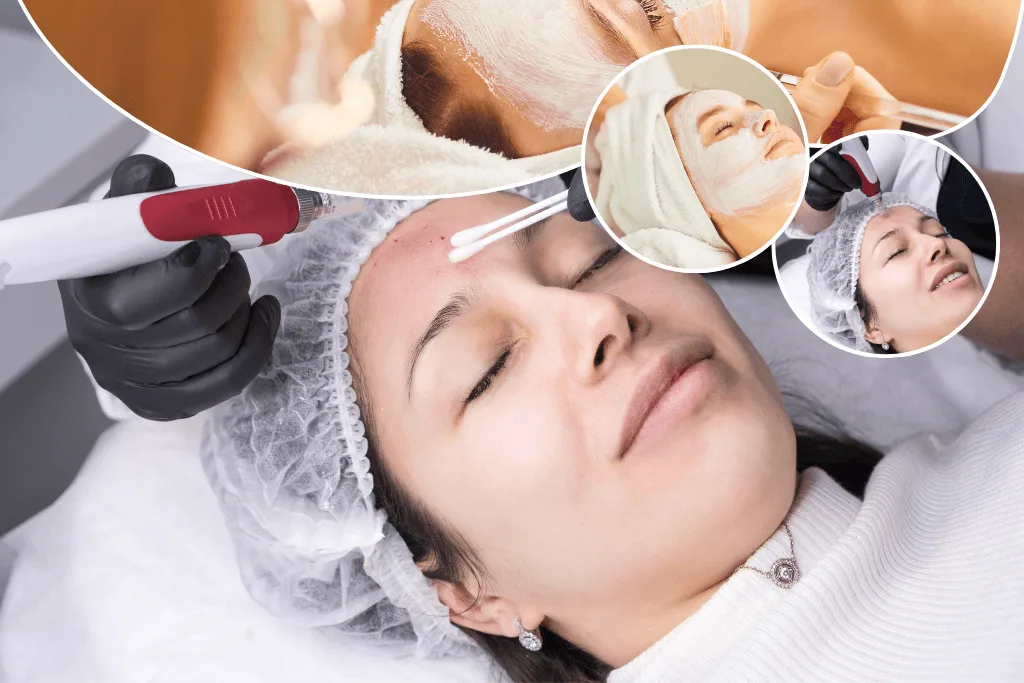
Microneedling is a treatment that uses very fine, sterile needles to create thousands of controlled micro-channels in the skin. Those tiny punctures are not the point — the repair response they trigger is. The skin reads the micro-injury as damage, floods the area with growth factors, and lays down new collagen and elastin over the following weeks. That is why it is properly called collagen induction therapy.
Nothing is injected in a standard session. No pigment is removed. The treatment simply asks your skin to rebuild itself, in a controlled way, in the places you choose.
How collagen induction therapy actually works
The response unfolds in three overlapping phases.
Inflammation (days 0–3). The micro-channels close within roughly an hour, but the signalling continues. Platelets release growth factors, blood flow increases, and immune cells arrive to clear debris. This is the redness phase — it looks like mild sunburn and it means the process started.
Proliferation (days 3–21). Fibroblasts — the cells that manufacture collagen — migrate into the treated zone and begin producing type III collagen, the fast, temporary kind. New capillaries form. Skin starts to feel firmer and smoother, though what you are feeling at this stage is scaffolding, not the finished result.
Remodelling (weeks 4–24). The soft type III collagen is gradually replaced with type I collagen — the dense, organised, structural kind that gives skin its resilience. This is slow, quiet work with no visible drama, and it is where the real change happens. It is also why the honest answer to “when will I see results?” is four to six weeks for the first shift and three to six months for the full picture.
Why sessions sit four to six weeks apart
That timeline is not a booking convention — it maps to biology. Treating again before the proliferation phase has finished means adding new injury to tissue that is still building, which raises inflammation without adding collagen. The spacing lets one wound-healing cycle complete before the next begins. Most people need three to six sessions for textural concerns, and more for established scarring.
Does needle depth matter?
It matters more than almost anything else. Shallower settings (around 0.25–0.5 mm) work in the epidermis and improve tone, product absorption and fine surface texture. Deeper settings reach the dermis, where collagen actually lives, and are what atrophic acne scarring requires. Depth is adjusted region by region in a single session — the skin over the cheekbone, the forehead and the area around the nose all tolerate different settings. This is the part that separates a professional treatment from an at-home roller, and it is the reason home devices are limited to depths too shallow to remodel anything.
What the healing week actually looks like
Day 0. Redness, warmth, a tight feeling. Skin looks flushed for several hours.
Days 1–2. Redness fades toward pink. Skin may feel rough, like fine sandpaper. Slight swelling is normal, particularly under the eyes.
Days 3–5. Light flaking or dryness as the surface turns over. Resist exfoliating it — let it shed on its own.
Days 5–7. Skin looks brighter and slightly plumper. This is the early glow, and it is largely hydration and blood flow rather than new collagen.
Through that week, skip active ingredients — retinoids, vitamin C, acids — and anything fragranced. Use a bland moisturiser and a broad-spectrum SPF 30 or higher. New collagen forms just below a surface that is temporarily more vulnerable to UV, and Southwestern Ontario’s snow glare in January does more damage than people expect. Sunscreen is not an optional add-on here; unprotected sun exposure after treatment is a common cause of post-inflammatory pigmentation.
Does microneedling hurt?
Sensation is best described as a rapid, prickling vibration with pressure. A topical numbing cream applied 20–30 minutes beforehand makes the bulk of the face comfortable for most people. Bonier areas — forehead, hairline, jawline, along the nose — are sharper regardless of numbing, because there is less tissue between needle and bone. Deeper settings for scarring feel more intense than surface work. Almost everyone finds it manageable; nobody finds it relaxing.
Who microneedling is not suitable for
It is not appropriate over active acne breakouts or any active infection, on skin currently treated with isotretinoin, or for anyone with a history of keloid scarring. Uncontrolled eczema or psoriasis in the treatment area, active cold sores, and pregnancy are also standard contraindications. Melanin-rich skin tolerates microneedling well — it is one of the few resurfacing options that does not rely on heat or acid, which is precisely why it suits Fitzpatrick IV–VI skin — but technique and aftercare still matter, because any inflammatory event can trigger pigment.
If you are unsure whether your concern is textural or pigmentary, that distinction changes the answer entirely. Our guide to the four types of acne scars and what each responds to walks through how to tell them apart, and how often you should get a facial explains the turnover cycle behind treatment intervals.
Frequently asked questions
Is microneedling the same as dermarolling at home? No. Professional devices use a stamping motion at adjustable, controlled depths; home rollers drag at a fixed, shallow depth and carry a real infection risk if not sterilised properly.
How many sessions will I need? Three to six for texture, tone and fine lines. Atrophic acne scarring typically needs six or more, spaced four to six weeks apart.
Can I wear makeup afterwards? Wait a full 24 hours. The micro-channels close quickly but the barrier is still recovering, and mineral makeup on day two is a gentler re-entry than a full base on day one.
Will it help pigmentation? Indirectly. Microneedling improves texture and can support pigment treatment, but melasma and post-inflammatory hyperpigmentation need pigment-specific approaches rather than collagen stimulation alone.
Written by Parull G Chandna, Advanced & Medical Aesthetics at Kaaya Skin & Hair Studio, London, Ontario. To discuss whether collagen induction suits your skin, see our professional skin care treatments in London, Ontario.